What is the welding speed of a high frequency welding machine?
As a high - frequency welding machine supplier, I often encounter inquiries about the welding speed of our machines. The welding speed of a high - frequency welding machine is a crucial parameter that significantly impacts production efficiency, cost - effectiveness, and the overall quality of the welded products. In this blog post, I will delve into the concept of high - frequency welding machine welding speed, the factors that influence it, and how it relates to different types of our welding equipment.
Understanding High - Frequency Welding
High - frequency welding is a process that uses electromagnetic induction to heat the edges of a workpiece in a very short time. The alternating current generates eddy currents on the surface of the metal, and the resistance of the metal causes the heating effect. Once the metal reaches its melting point, pressure is applied, and the two edges are joined together. This method is widely used in industries such as steel pipe manufacturing, where it has proven to be fast, efficient, and capable of producing high - quality welds.
Defining Welding Speed
The welding speed of a high - frequency welding machine refers to the rate at which the welding process is carried out, usually measured in meters per minute (m/min) or inches per minute (in/min). In the context of pipe manufacturing, for example, it represents the speed at which the pipe moves through the welding zone while the high - frequency welding occurs. A higher welding speed generally means that more products can be produced within a given time frame, leading to increased productivity.
Factors Affecting Welding Speed
1. Material Properties
The type and thickness of the material being welded play a significant role in determining the welding speed. Different metals have different electrical and thermal conductivities, which affect how quickly they can be heated by the high - frequency current. For example, materials with high electrical conductivity, such as copper, may require more energy to reach the melting point compared to materials like steel. Thicker materials also take longer to heat through, so the welding speed will need to be adjusted accordingly.
2. Welding Power
The power output of the high - frequency welding machine is directly related to the welding speed. A machine with higher power can generate more heat in a shorter time, allowing for a faster welding speed. However, increasing the power too much can cause issues such as overheating, excessive melting, and poor weld quality. Therefore, it is essential to find the right balance between power and speed to achieve optimal results.
3. Weld Joint Design
The design of the weld joint, including its shape and size, can impact the welding speed. Complex joint designs may require more time to ensure proper heating and fusion. For instance, a butt joint may be welded faster than a lap joint due to its simpler geometry.
4. Machine Settings and Configuration
The settings of the high - frequency welding machine, such as the frequency of the current, the pressure applied during welding, and the cooling system, all contribute to the welding speed. Correctly adjusting these parameters can optimize the welding process and increase the speed.


Typical Welding Speeds for Different Products
Steel Pipe Manufacturing
In the steel pipe industry, the welding speed can vary depending on the pipe diameter, wall thickness, and material grade. For small - diameter pipes with thin walls, welding speeds can reach up to 60 m/min or even higher. As the diameter and wall thickness increase, the welding speed will generally decrease. For example, large - diameter pipes with thick walls may have a welding speed of around 10 - 20 m/min.
Our High Frequency Welding Equipment is designed to handle a wide range of pipe sizes and wall thicknesses, with adjustable welding speeds to meet different production requirements.
Other Applications
In addition to steel pipe manufacturing, high - frequency welding machines are used in other applications such as the production of spiral pipes, ERW pipes, and square pipes.
- Spiral Pipe Production: The Spiral Pipe Forming Machine integrated with high - frequency welding technology can achieve welding speeds that are well - suited to the continuous production of spiral pipes. The speed is influenced by the spiral angle, pipe diameter, and other factors.
- ERW Pipe Manufacturing: ERW Pipe Making Machine uses high - frequency welding to produce electric resistance welded pipes. Welding speeds for ERW pipes typically range from 15 - 50 m/min, depending on the specific pipe specifications.
- Square Pipe Production: The Square Pipe Manufacturing Machine equipped with high - frequency welding capabilities can produce square pipes at speeds that vary according to the side length and wall thickness of the pipes.
Importance of Optimizing Welding Speed
Optimizing the welding speed of a high - frequency welding machine offers several benefits:
Cost Efficiency
A higher welding speed means more products can be produced in less time, which reduces labor costs and increases the return on investment. Additionally, faster welding speeds can lead to lower energy consumption per unit of production, further reducing costs.
Quality Assurance
When the welding speed is properly optimized, it can result in high - quality welds. A consistent and appropriate welding speed helps to ensure uniform heat distribution, proper fusion, and minimal defects such as cracks or porosity.
Competitiveness in the Market
By being able to produce products at a faster rate with high quality, manufacturers can meet market demand more effectively and gain a competitive edge over their rivals.
How Our High - Frequency Welding Machines Can Help
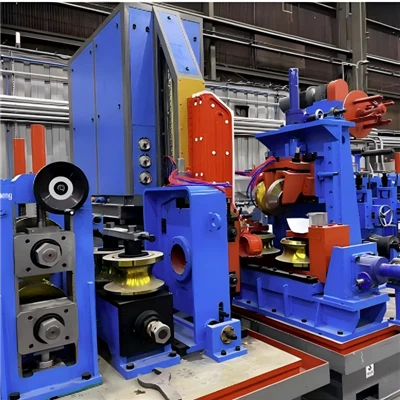
As a high - frequency welding machine supplier, we offer a range of products that are designed to provide high - speed and high - quality welding solutions. Our High Frequency Pipe Mill combines advanced technology with user - friendly design, allowing for easy adjustment of welding speed and other parameters.
Our team of experts can also provide customized solutions based on your specific production requirements. Whether you need to weld pipes of different sizes, materials, or for different applications, we can help you configure the machine to achieve the optimal welding speed.
Contact Us for Procurement and Consultation
If you are interested in purchasing high - frequency welding machines and want to learn more about their welding speeds and how they can fit into your production process, please contact us. Our dedicated sales team is ready to answer all your questions and assist you through the procurement process. We look forward to working with you to improve your production efficiency and product quality.