Steel pipes used for water transmission, oil and gas systems, industrial processing, construction, and other pressure applications must withstand the forces generated during service. A pipe may appear dimensionally correct and have a satisfactory surface finish while still containing a defect that could cause leakage or failure under pressure.
This is why Hydrostatic Testing of Steel Pipes is an important part of quality control in many pipe manufacturing processes.
Hydrostatic testing uses water or another suitable liquid to apply controlled internal pressure to the pipe. The pipe is held at the specified test pressure for a defined period while the system monitors pressure stability and checks for leakage or other abnormal behavior.
Rather than being viewed only as a final inspection step, hydrostatic testing can also provide valuable information about production quality. Test results can help manufacturers identify problems related to welding, forming, material quality, end preparation, or production parameters.
What Hydrostatic Testing Actually Verifies
Hydrostatic testing primarily evaluates a pipe's ability to withstand internal pressure under specified test conditions.
During testing, the pipe is filled with water and air is removed as required. Pressure is then increased in a controlled manner until the specified test pressure is reached.
The pipe is observed during the holding period.
Important observations can include
- Pressure stability
- Visible leakage
- Leakage around welds
- Leakage at pipe ends
- Abnormal deformation
- Pressure loss
- Equipment alarms
The exact test pressure and holding time depend on the applicable product specification, pipe type, dimensions, material, and intended application.
Why Water Is Used for Pressure Testing
Water is commonly used because it is relatively incompressible compared with gases.
When a pipe is pressurized with water, the amount of stored energy is significantly lower than would be associated with compressible gases at comparable pressure conditions.
This makes hydrostatic testing a practical method for pressure verification when the applicable standard requires it.
The water used for testing should also be managed properly. Depending on the material and production environment, water quality, temperature, cleanliness, and treatment may need to be controlled.
The Testing Process From a Production Perspective
A typical hydrostatic testing sequence involves several stages.
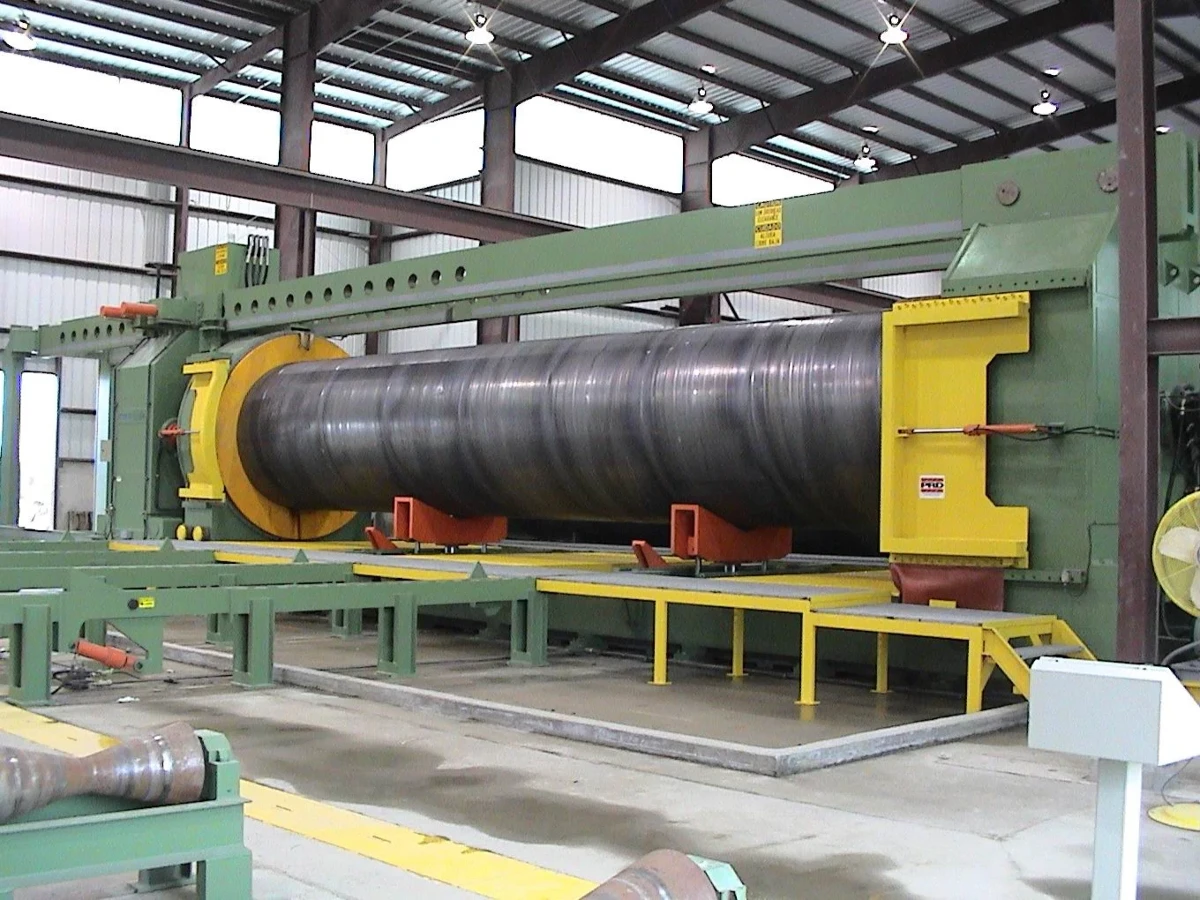
First, the finished pipe is transferred to the testing station. The pipe ends are positioned correctly and sealed with suitable test heads.
The pipe is then filled with water. Air trapped inside the pipe should be minimized because trapped air can affect test behavior.
After filling, the pressure system gradually increases the internal pressure to the required test level.
The system then maintains the pressure for the specified holding period while the pipe is inspected.
After the test is completed, pressure is released in a controlled manner and the water is discharged or recovered.
The tested pipe can then proceed to the next production stage.
The Importance of Proper Pipe End Sealing
The test heads and sealing system play an important role in hydrostatic testing.
If the sealing system is not properly positioned or maintained, leakage may occur at the pipe ends. This can make it difficult to determine whether the problem comes from the pipe itself or from the testing equipment.
For this reason, sealing components should be selected according to the pipe diameter, wall thickness, test pressure, and machine design.
Worn seals should be replaced according to the manufacturer's maintenance requirements.
Pressure Control Must Be Stable
Pressure stability is essential for obtaining meaningful test results.
The pressure should be increased gradually rather than applied in an uncontrolled manner.
A modern Pipe Hydro Testing Machine can use pumps, valves, pressure sensors, and PLC control to regulate the testing process.
The control system can monitor the pressure and maintain the required test level automatically.
If the pressure falls unexpectedly, the system can generate an alarm or stop the test depending on its configuration.
Pressure Loss Does Not Always Mean the Same Thing
A reduction in test pressure requires investigation.
Possible causes can include
- Pipe leakage
- End-seal leakage
- Valve leakage
- Pipe temperature changes
- Air remaining in the pipe
- Measurement-system issues
- Pump or hydraulic-system problems
Therefore, operators should not immediately assume that every pressure drop means the pipe itself has failed.
The testing equipment should be checked alongside the pipe so that the actual cause can be identified.
Weld Quality and Hydrostatic Testing
For welded pipes, the weld seam is one of the most important areas to evaluate.
Welding defects such as incomplete fusion, lack of penetration, cracks, or other discontinuities can potentially affect pressure integrity.
Hydrostatic testing can provide a practical pressure-resistance check after the pipe has been manufactured.
However, hydrostatic testing and non-destructive testing serve different purposes.
Ultrasonic testing, radiographic testing, and other NDT methods can detect or evaluate internal or surface discontinuities without relying on leakage during a pressure test.
For this reason, manufacturers may use hydrostatic testing together with other inspection methods.
Hydro Testing and ERW Pipes
Electric resistance welded pipes require careful control of the welding process.
Parameters such as strip edge condition, welding temperature, pressure, line speed, and alignment can influence weld quality.
Hydrostatic testing can then be used as part of the quality-control system to verify pressure resistance according to the applicable specification.
When hydro testing is combined with weld inspection and dimensional inspection, manufacturers can obtain a broader understanding of pipe quality.
Hydro Testing and Seamless Pipes
Seamless pipes do not contain a longitudinal welded seam, but they can still contain manufacturing-related defects or imperfections.
Potential concerns can involve material quality, wall-thickness variation, surface conditions, dimensional accuracy, and other production factors.
Hydrostatic testing provides an additional method for verifying the pipe's pressure resistance where required by the relevant specification.
This demonstrates why hydro testing is not only a weld inspection technique. It can be applicable to different categories of pressure-containing steel pipes.
Test Pressure Depends on the Specification
There is no single hydrostatic test pressure suitable for every steel pipe.
The required pressure can depend on
- Pipe outside diameter
- Wall thickness
- Steel grade
- Product standard
- Intended application
- Design requirements
- Applicable calculation or specification
Manufacturers should therefore follow the applicable product standard and customer specification rather than selecting a pressure based only on the machine's maximum capacity.
The test system should be capable of achieving the required pressure with appropriate control and measurement accuracy.
The Role of Pressure Sensors
Pressure sensors provide the measurement data required during testing.
Sensor selection should consider the expected pressure range, accuracy, environmental conditions, connection method, and compatibility with the control system.
A sensor with an unsuitable measurement range may provide poor resolution or inaccurate results.
Regular calibration is therefore an important part of maintaining the reliability of Steel Pipe Pressure Testing.
Calibration and Test Reliability
Calibration is essential because the test result depends on accurate pressure measurement.
A pressure gauge or sensor should be checked against a suitable reference according to the required calibration procedure.
Calibration records can provide traceability and support quality documentation.
If a pressure sensor is found to be inaccurate, previously recorded test results may need to be reviewed according to the manufacturer's quality-control procedure.
PLC Automation in Hydrostatic Testing
Modern hydro testing systems can automate much of the testing sequence through a PLC.
The PLC can control
- Water filling
- Air removal sequence
- Pressure increase
- Pressure holding
- Pressure release
- Test timing
- Alarm conditions
- Test result recording
The HMI allows operators to enter or select the required test parameters.
Automation can reduce manual intervention and help standardize the testing procedure between different pipes.
Automatic Test Data Recording
A modern hydrostatic testing system can record important information for each test.
Typical data may include
- Pipe identification
- Pipe size
- Material grade
- Test pressure
- Holding time
- Test result
- Production batch
- Date and time
- Operator information
The exact data structure depends on the factory's quality-control system.
Automatic recording can improve traceability and reduce the possibility of manual recording errors.
How Hydro Testing Supports Production Control
Hydrostatic testing can provide more than a pass-or-fail result.
If a production batch repeatedly shows failures in a particular area, the manufacturer can investigate upstream production parameters.
For welded pipes, repeated failures may lead to examination of welding conditions or alignment.
If failures occur around pipe ends, the manufacturer may inspect end preparation or handling procedures.
If pressure loss is repeatedly associated with the same testing station, the equipment itself may require inspection.
This creates a feedback loop between testing and production.
Using Test Results to Identify Production Problems
A useful quality-control system does not simply record failed pipes and remove them from production.
Instead, failure information can be analyzed for patterns.
For example, manufacturers can compare failures according to
|
Production Factor |
Possible Investigation |
|
Pipe size |
Check size-specific settings |
|
Material grade |
Review raw material quality |
|
Production shift |
Check operating conditions |
|
Welding batch |
Review welding parameters |
|
Testing station |
Inspect test equipment |
|
Pipe end |
Check sealing or end preparation |
|
Production date |
Compare production records |
This approach can help identify recurring problems rather than treating every failed pipe as an isolated incident.
Hydro Testing and Other Inspection Methods
Hydrostatic testing is only one part of a comprehensive pipe inspection system.
Depending on the product and specification, other methods can include
- Visual inspection
- Dimensional inspection
- Ultrasonic testing
- Eddy current testing
- Radiographic testing
- Mechanical testing
- Chemical analysis
- Surface inspection
Each method evaluates different characteristics.
For example, ultrasonic testing can detect certain internal discontinuities, while dimensional inspection verifies geometry. Hydrostatic testing evaluates pressure resistance under specified conditions.
Combining appropriate inspection methods can provide broader quality assurance.
Water Management During Production
Hydro testing can consume significant quantities of water, particularly in high-volume pipe manufacturing facilities.
Factories should therefore consider water recovery and reuse where practical.
The water may need filtration or treatment depending on the testing system and pipe material.
Proper drainage is also important because uncontrolled water discharge can create workplace safety issues and affect the production environment.
Efficient water management can reduce operating costs while maintaining suitable testing conditions.
Protecting the Pipe After Testing
The hydrostatic test itself can introduce moisture into the pipe.
For carbon steel pipes, leaving water inside the pipe for an extended period can contribute to corrosion.
Therefore, after testing, the pipe may require proper drainage and drying depending on the product specification and storage conditions.
Drying requirements can be particularly important when pipes will be stored for extended periods or transported through humid environments.
Safety During Hydrostatic Testing
Hydrostatic testing involves high internal pressure and therefore requires appropriate safety controls.
The testing area should be designed to protect personnel from potential hazards associated with pressurized equipment.
Important safety considerations include
- Properly rated test heads
- Secure pipe positioning
- Pressure-rated hoses and valves
- Controlled pressurization
- Emergency pressure release
- Safety interlocks
- Restricted access during testing
- Regular equipment inspection
Operators should follow the machine manufacturer's safety procedures and the applicable workplace regulations.
Choosing a Hydro Testing Machine
When selecting a Pipe Hydro Testing Machine, manufacturers should consider more than maximum pressure.
Important specifications include
- Pipe diameter range
- Pipe length range
- Maximum test pressure
- Number of testing stations
- Pump capacity
- Pressure-control accuracy
- Test holding time
- Automation level
- PLC and HMI configuration
- Data recording capability
- Water circulation system
- Pipe loading and unloading method
The machine should be matched to the factory's actual pipe production range.
Improving Testing Efficiency
Production efficiency can be improved by reducing unnecessary handling between manufacturing and testing.
Automated pipe transfer systems can move pipes into the testing station with less manual intervention.
Multiple testing stations can also allow one pipe to be tested while another is being loaded or unloaded.
For high-volume production, the overall cycle time should be evaluated rather than looking only at pump speed.
A faster pump does not necessarily produce higher output if loading, sealing, pressure stabilization, or unloading takes considerably longer.
Common Problems in Hydrostatic Testing
Several problems can affect testing efficiency and accuracy.
Unstable Pressure can result from pump problems, valve leakage, air inside the pipe, or control-system issues.
End Leakage can occur when seals are worn or incorrectly positioned.
Incorrect Test Results can be associated with sensor calibration problems or incorrect test parameters.
Slow Testing Cycles may result from insufficient pump capacity, inefficient water filling, or excessive manual handling.
Corrosion After Testing can occur when water is not properly removed from carbon steel pipes.
Identifying these problems early can improve both test reliability and production efficiency.
A More Complete Approach to Pipe Quality
Hydrostatic testing should be considered as part of the complete manufacturing quality system.
Raw material inspection, pipe forming, welding or seamless production, heat treatment where applicable, dimensional control, NDT, hydro testing, end finishing, and final inspection all contribute to the final product.
Each stage provides different information.
The objective is not simply to test the finished pipe as quickly as possible. The larger goal is to establish a controlled manufacturing process in which defects are prevented, detected, documented, and corrected.
Conclusion
Hydrostatic Testing of Steel Pipes provides an important method for verifying pressure resistance and identifying leakage or other pressure-related problems under controlled conditions.
Its value extends beyond the final pass-or-fail decision. When test results are properly recorded and analyzed, hydro testing can help manufacturers identify recurring production problems, improve process control, maintain traceability, and reduce the risk of defective pipes reaching customers.
A reliable Pipe Hydro Testing Machine should provide stable pressure control, accurate measurement, dependable sealing, appropriate automation, and suitable data recording.
At the same time, hydro testing should not be treated as a replacement for other inspection methods. Ultrasonic, radiographic, eddy current, visual, dimensional, and mechanical inspections each provide different information about pipe quality.
The most effective production approach is therefore to integrate hydrostatic testing into a broader quality-control system. When equipment, calibration, safety, water management, data recording, and production feedback are properly coordinated, hydro testing becomes an important tool not only for checking finished pipes but also for improving the overall reliability and consistency of pipe manufacturing.