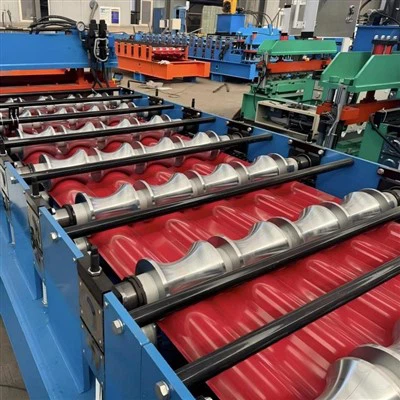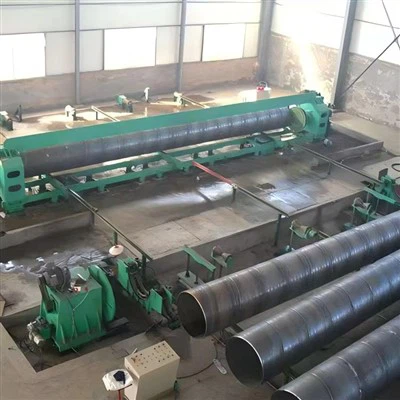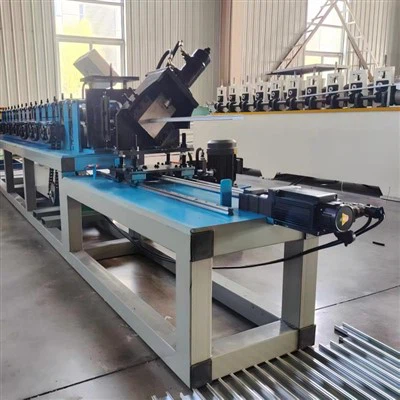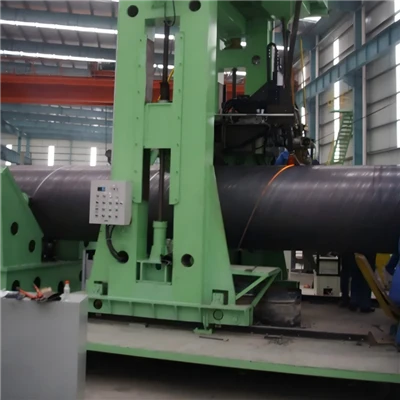
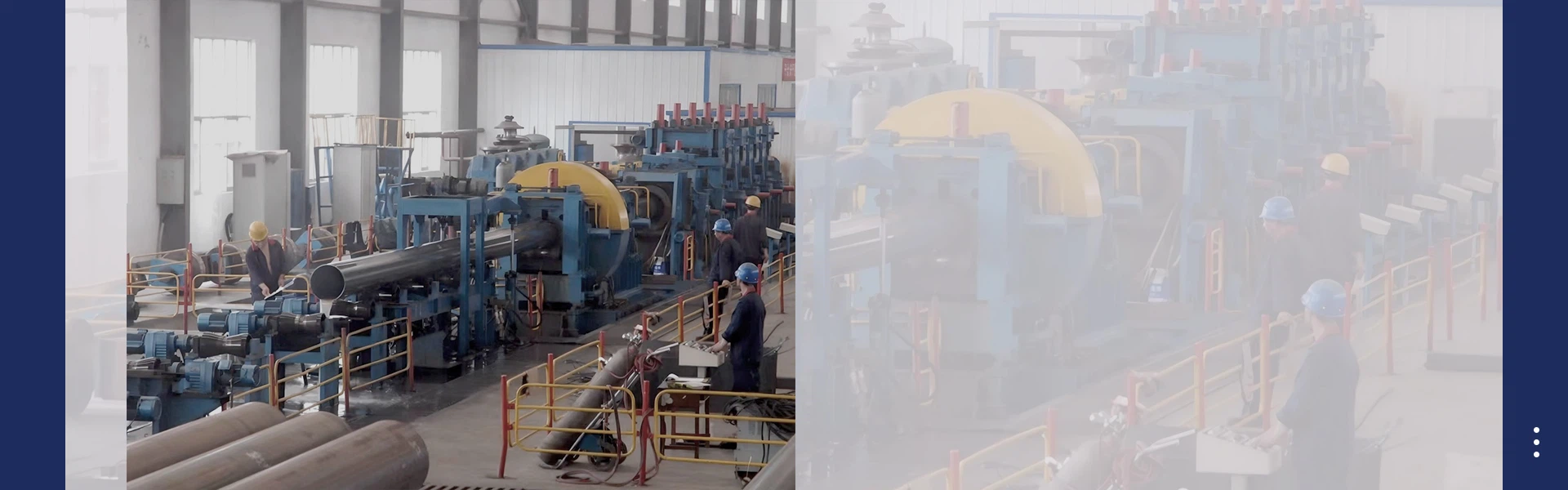
Production speed is an important factor in modern Steel Pipe Production. Manufacturers need to produce sufficient quantities to meet delivery schedules while keeping operating costs under control. However, increasing line speed does not automatically mean higher production efficiency.
Steel pipe manufacturing involves several processes that must work together. Depending on the pipe type, these can include coil preparation, forming, welding, sizing, cutting, inspection, testing, and finishing. Each stage has a practical operating range.
If the production speed is increased beyond what the material, machine, or process can handle reliably, dimensional variation and quality problems can appear. Welding stability can change, forming accuracy can decrease, cutting errors can increase, and inspection systems may have less time to respond to defects.
Therefore, the objective should not simply be to operate a Pipe Production Line at the highest possible speed. The more useful objective is to find a production speed at which output, quality, machine stability, and material utilization remain balanced.
Production Speed Is More Than Line Speed
Production speed is often expressed in meters per minute. However, actual production efficiency depends on much more than this number.
A pipe line running at 30 m/min does not necessarily produce more acceptable pipes per hour than a line running at 25 m/min.
The actual output can be affected by
- Setup time
- Coil changing
- Welding adjustments
- Cutting time
- Inspection
- Rejected pipes
- Machine stoppages
- Maintenance
- Material handling
- Product changeover
For this reason, manufacturers should distinguish between theoretical line speed and effective production output.
A slightly lower operating speed can sometimes provide more stable production and a higher percentage of finished pipes that meet specification.
How Speed Influences Material Forming
Before welding or sizing, the steel strip must be progressively formed into the required pipe shape.
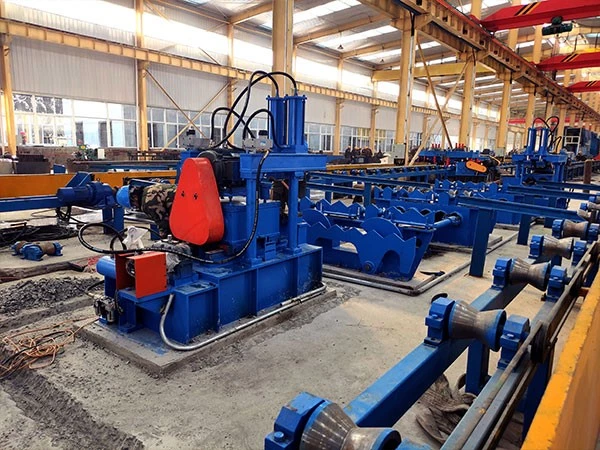
The forming section uses multiple rollers to gradually bend the strip. At a controlled speed, the material has predictable interaction with the rollers.
When the speed changes, the dynamic behavior of the forming system can also change.
Potential effects include
- Increased vibration
- Material tracking problems
- Uneven edge alignment
- Greater roller wear
- Increased sensitivity to material variation
- Dimensional instability
This does not mean high-speed forming is inherently unsuitable. Properly designed forming equipment can operate at high speeds.
The important point is that the machine must be engineered for the intended production range.
Speed and ERW Pipe Welding
For ERW pipes, production speed has a particularly important relationship with the welding process.
In high-frequency electric resistance welding, the strip edges are heated and pressed together to form the longitudinal weld seam.
The welding system must maintain appropriate relationships between
- Line speed
- Electrical power
- Edge preparation
- Welding pressure
- Strip thickness
- Material grade
If line speed changes without corresponding adjustment of the welding parameters, the heat input can become unsuitable.
Too little effective heat input may contribute to incomplete bonding, while excessive heat can affect the weld area and surrounding material.
Therefore, welding parameters should be coordinated with production speed rather than treating speed as an independent setting.
Speed and Submerged Arc Welding
The relationship between speed and welding is also important in submerged arc welding processes.
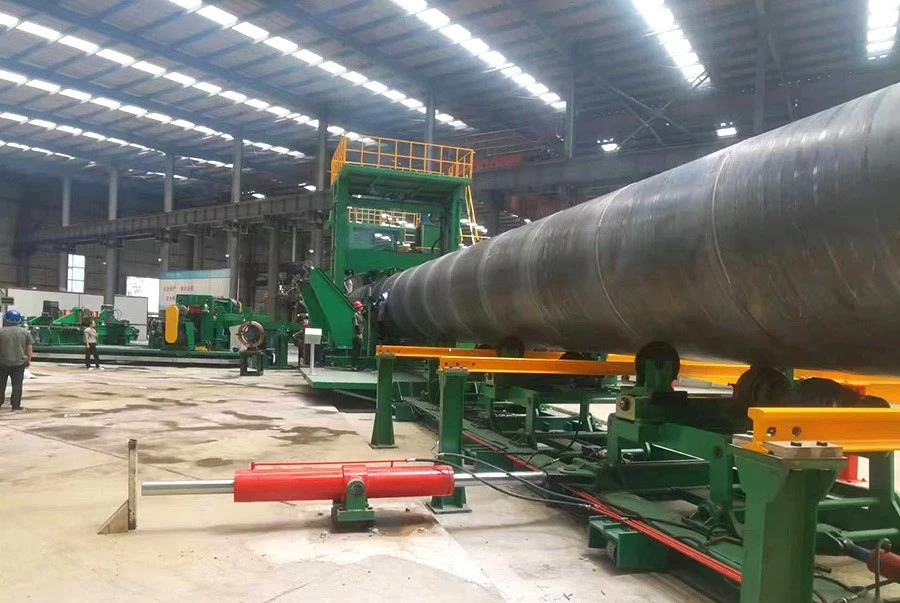
SAW uses a continuously fed welding wire and granular flux. The welding parameters need to correspond to the movement of the pipe or workpiece.
Changes in travel speed can influence the amount of heat deposited per unit length.
For longitudinal or spiral submerged arc welded pipes, manufacturers must consider the interaction between
- Welding current
- Welding voltage
- Wire feed speed
- Travel speed
- Flux condition
- Joint geometry
A change in production speed may therefore require corresponding process adjustments.
Forming Speed and Pipe Diameter
Pipe diameter also affects how production speed should be selected.
Smaller-diameter pipes and larger-diameter pipes can have significantly different forming requirements.
For a given production line, changing diameter may require changes to roller settings, forming geometry, welding parameters, sizing conditions, and cutting arrangements.
Therefore, a machine should not be judged by one maximum speed figure without considering the pipe size associated with that speed.
A realistic production specification should state the expected speed range for the relevant pipe diameter and thickness.
Wall Thickness Changes the Production Balance
Wall thickness is another major factor.
Thicker material generally requires greater forming force and can require different welding conditions. It may also affect cutting requirements and inspection speed.
A production line designed for thin-wall pipe cannot necessarily process thick-wall material at the same speed.
For example, increasing thickness may require lower production speed to maintain stable forming and welding conditions.
This is why manufacturers often define different production-speed ranges for different combinations of diameter and thickness.
Dimensional Accuracy at Higher Speeds
Pipe dimensions must remain within the required tolerances throughout production.
Important parameters include
- Outside diameter
- Wall thickness
- Roundness
- Straightness
- Length
- Weld-seam position
Higher production speed can make dimensional control more demanding because the machine has less time to correct material tracking or forming deviations.
Small changes in roller alignment can become more noticeable when the line is operating at higher speed.
This makes accurate roller setup and continuous monitoring particularly important.
Sizing Section Stability
After welding, many pipe production lines use sizing or calibration stands to achieve the required final dimensions.
The sizing section must compensate for forming and welding effects while producing the final outside diameter and shape.
At higher speeds, excessive adjustment pressure can increase surface marking or deformation.
Insufficient adjustment, on the other hand, may leave dimensional variation.
The correct balance depends on the pipe specification, material properties, roller design, and production speed.
Cutting Accuracy Depends on Synchronization
After the pipe has reached the required length, it must be cut accurately.
At low production speeds, small timing errors may produce relatively small length variations. As speed increases, the same timing error can produce a larger difference in cutting position.
Modern production lines therefore use encoders and control systems to measure pipe movement and synchronize the cutting operation.
The cutting system must be matched to the line speed and pipe dimensions.
Inspection Systems Must Match Production Speed
Increasing production speed without considering inspection capacity can create a quality-control bottleneck.
For example, a production line may manufacture pipes faster than operators or inspection equipment can properly inspect them.
Automated inspection systems can help solve this problem.
Depending on the pipe type, manufacturers may use
- Ultrasonic testing
- Eddy current testing
- Visual inspection
- Dimensional measurement
- Hydrostatic testing
- Radiographic testing
Inspection equipment must be capable of operating at the required production speed while maintaining the necessary sensitivity and accuracy.
Speed and Ultrasonic Inspection
For automated ultrasonic testing, inspection speed can influence how much time the system has to detect and process signals.
The inspection system needs suitable probe configuration, signal processing, scanning coverage, and data acquisition speed.
If the pipe moves too quickly for the inspection system's designed scanning capability, defects may not be evaluated with the intended reliability.
Therefore, inspection capacity should be considered when determining the maximum practical production speed.
Surface Quality Can Also Be Affected
Production speed can influence the surface condition of the finished pipe.
Higher speed can increase the effects of
- Roller contact
- Material vibration
- Guide friction
- Cooling conditions
- Handling equipment
For coated or surface-sensitive materials, these factors can become particularly important.
A pipe may meet dimensional requirements but still require additional attention if the surface contains scratches, dents, or other unacceptable marks.
Speed and Heat Management
Heat generated during welding and other production processes needs to be controlled.
When production speed changes, heat input and heat distribution can change as well.
Cooling systems therefore need to be capable of maintaining stable process conditions.
In ERW production, for example, the welding process creates localized heat that must be controlled before the pipe proceeds through subsequent operations.
If cooling is insufficient or inconsistent, dimensional stability and surface condition can be affected.
Production Speed and Machine Wear
Operating at high speed can increase the mechanical workload on production equipment.
Rollers, bearings, shafts, gearboxes, cutting components, welding equipment, and other moving parts experience repeated operation.
If maintenance intervals are not adjusted according to actual operating conditions, wear can gradually affect production accuracy.
A worn roller may introduce dimensional variation. A worn bearing can contribute to vibration. A degraded cutting component can affect cut quality.
Therefore, production speed should be considered when establishing preventive maintenance schedules.
The Relationship Between Speed and Material Waste
Production problems at high speed can increase material waste.
A forming problem may result in a long section of defective pipe before the operator identifies the issue.
Similarly, an incorrect welding parameter can affect multiple pipes if the problem is not detected quickly.
Automatic monitoring can reduce this risk by identifying abnormal conditions earlier.
Manufacturers can also use statistical production data to determine whether quality problems increase at particular speed ranges.
Finding the Practical Operating Speed
The best operating speed is not necessarily the highest speed the machine can physically achieve.
Instead, manufacturers should consider
- Product quality
- Production capacity
- Machine stability
- Material utilization
- Inspection capability
- Maintenance requirements
- Energy consumption
- Operator workload
For one product, 30 m/min may be appropriate. For another product made from thicker or higher-strength steel, 20 m/min may provide better overall production performance.
The correct speed should therefore be determined through controlled production trials and quality verification.
Speed Changes During Product Changeover
Production speed may need to change when switching between pipe sizes or material specifications.
For example, a manufacturer may move from a small-diameter, thin-wall product to a larger-diameter, thicker-wall product.
Instead of maintaining the same speed setting, operators should establish appropriate parameters for the new product.
A well-designed PLC system can store production recipes to simplify this process.
Stored parameters can include forming settings, welding parameters, cutting length, production speed, and inspection settings where supported by the machine.
Automatic Monitoring Improves Speed Control
Modern Steel Pipe Manufacturing increasingly uses sensors and automation to monitor production conditions.
Possible monitoring parameters include
- Line speed
- Welding current
- Welding voltage
- Material position
- Pipe diameter
- Cutting length
- Motor load
- Temperature
- Pressure
- Inspection signals
When these parameters are monitored continuously, operators can identify abnormal conditions before they result in large quantities of defective products.
This allows production speed to become a controlled variable rather than simply a number entered into the machine.
Balancing Speed and Quality
A successful production line must balance speed with quality.
Operating too slowly can reduce productivity and increase manufacturing costs. Operating too quickly can increase instability, waste, equipment stress, and inspection challenges.
The ideal operating point is therefore the speed at which the line produces the required quantity while maintaining stable quality and acceptable operating costs.
This balance is particularly important for manufacturers producing multiple pipe specifications on the same line.
How Manufacturers Can Optimize Production Speed
A practical approach is to establish validated speed ranges for different product categories.
For example, the factory can record production data for different combinations of
|
Parameter |
Example Production Variable |
|
Pipe diameter |
Small, medium, large |
|
Wall thickness |
Thin, medium, thick |
|
Steel grade |
Different strength levels |
|
Welding method |
ERW, SAW |
|
Production speed |
Validated operating range |
|
Inspection method |
UT, hydro, visual, etc. |
|
Rejection rate |
Recorded by batch |
|
Downtime |
Recorded by production period |
This information can help manufacturers identify the speed ranges that provide stable production.
Quality Should Determine Sustainable Speed
A sustainable production speed is one that can be maintained over an extended production period without causing unacceptable quality variation or excessive machine downtime.
Short-term testing at maximum speed can demonstrate what the machine is capable of doing, but long-term production data provides a better indication of practical performance.
Manufacturers should therefore monitor quality results over complete production batches rather than evaluating speed using a short demonstration run.
Conclusion
Pipe Production Speed has a direct relationship with forming stability, welding conditions, dimensional accuracy, cutting performance, inspection capability, machine wear, and material utilization.
Increasing speed can improve output, but only when the complete Pipe Production Line is capable of maintaining stable conditions at that speed. If forming, welding, cooling, sizing, cutting, or inspection systems cannot keep pace, higher speed can result in more defects and greater production losses.
The appropriate production speed depends on the pipe diameter, wall thickness, material grade, welding process, machine configuration, and quality requirements.
For manufacturers, the goal should therefore not be to achieve the highest possible line speed. A better approach is to establish a validated operating range for each product and monitor quality performance within that range.
When production speed is properly coordinated with forming, welding, inspection, cooling, cutting, and automation systems, manufacturers can improve output without sacrificing dimensional accuracy or product consistency. This balance is one of the key factors in efficient and reliable Steel Pipe Production.