Recently Yashanway post a new machine - GRE Pipe Inner Curing Production Line, we hereby introduce this production line in two parts here.
What does GRE stand for in piping?
Glass fiber reinforced epoxy resin (GRE) pipeline systems are widely used in high-demand customers of ships and offshore industries, oil and gas, as well as the petrochemical sector.
Part one: Introduction of High & Low Pressure GRE Pipes
Severe corrosion of steel pipes in oilfield service is an inevitable problem, which has greatly driven the research and development of alternative petroleum pipeline products. In the early 1960s, the United States firstly developed glass fiber reinforced epoxy high-pressure fiberglass pipes to replace steel pipes for oil gathering and transportation pipelines, achieving remarkable economic and social benefits. Later, France, Italy and other countries successively launched similar products.
Such pipes feature outstanding advantages including excellent corrosion resistance, aging resistance, high pressure resistance and superior thermal insulation performance. Meanwhile, they have smooth inner walls with no wax deposition, low flow resistance and large conveying capacity, as well as easy installation, short construction period, low maintenance cost and long service life, presenting prominent comprehensive economic benefits, hence gaining wide popularity among all oil-producing countries.
In the 1990s, high-pressure glass fiber reinforced epoxy fiberglass pipes were widely applied in North America, with a popularization rate of 40% to 50% in South America. Although countries in North Africa and the Gulf region started the application relatively late, their market usage is now growing rapidly at an annual rate of 20%.
The high and low pressure fiber reinforced epoxy fiberglass pipes manufactured by our equipment are produced and tested in accordance with internationallyaccepted production and inspection specifications. They strictly comply with API Standards of the American Petroleum Institute, including Specification 15HR for High Pressure Fiberglass Line Pipe and Specification 15LR for Low Pressure Fiberglass Line Pipe, as well as China petroleum industry standards SY/T6267-2008 High Pressure Fiberglass Line Pipe, SY/T6266-2008 Low Pressure Fiberglass Line Pipe, and IMO Resolution A.753(18) Guidelines for Marine Plastic Piping Systems.
一, Product Specifications
Pipe Range: DN250 ~ DN600
Pipe Length: 8.9 Meters
Table 1 Main Technical Parameters of Products
| No. | Item Name (Standard) | Unit | Index |
|---|---|---|---|
| 1 | Appearance | - | Smooth and even, free of defects |
| 2 | Axial Tensile Stress (ASTM D2105) | MPa | 75 |
| 3 | Axial Compressive Stress (ASTM D695) | MPa | 130 |
| 4 | Hoop Tensile Modulus | MPa | 21500 |
| 5 | Hoop Tensile Stress (ASTM D1599) | MPa | 340 |
| 6 | Coefficient of Thermal Expansion (ASTM D696) | mm/mm/°C | 1.66×10⁻⁵ |
| 7 | Thermal Conductivity (ASTM D177) | W/(m·K) | 0.36 |
| 8 | Specific Gravity (ASTM D177) | - | 2.0 |
| 9 | Hazen-Williams Coefficient | - | 150 |
二.,Main Raw Materials & Sources
Main raw materials: Epoxy resin, glass fiber, curing agent, etc.
Part Two: Introduction of High and Low Pressure GRE Pipe Manufacturing Equipment
Ⅰ. Core Technology: Internal Curing Process
The principle of the traditional external curing process is as follows: the resin-impregnated fibers are wound onto the mandrel or liner, and then transferred into a curing oven or autoclave for heating until the material is fully cured. After curing, the pipe must be sent to a demolding machine to separate the pipe from the mold. Due to the characteristic of heating from the outside, the three main processes of external curing-winding, curing, and demolding-usually have to be completed on separate pieces of equipment: a winding machine, a curing oven, and a demolding machine. In addition, since most pipes are long and heavy, overhead lifting is required between processes, resulting in low production efficiency.
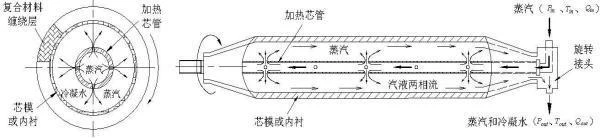
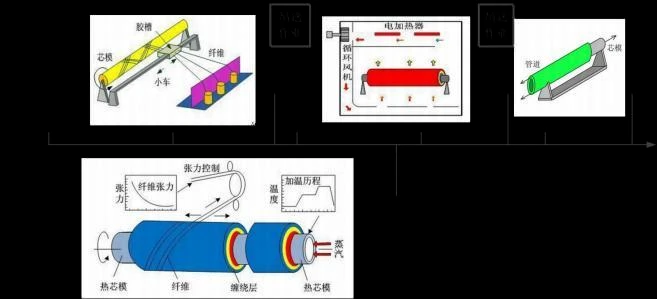
The internal curing process is as follows: Under the combined action of the reciprocating motion of the winding carriage and the rotational motion of the spindle, the resin-impregnated fibers are laid down according to the designed winding pattern onto an internally heatable mandrel. Inside the internally heated mandrel, there is a perforated core pipe through which steam can be introduced. High-pressure steam passes through the core pipe into the inner cavity of the mandrel, thereby heating and curing the composite materials that have been wound or are being wound onto the mandrel. After full curing, the composite materials undergo subsequent processes such as demolding, end grinding, and thread machining to form the final product.
The principle of the internal curing mandrel is shown in Figure 1
The comparison between the principles of the internal curing and external curing processes is shown in Figure 2. Since the mandrel itself can be heated, the internal curing process no longer requires external curing equipment such as curing ovens or autoclaves. This allows the three key processes of winding, curing, and demolding to be completed on a single machine, fundamentally solving the low-efficiency production problems of the traditional external curing method.
Table 1 presents a comparison between the internal curing process and the traditional external curing process. As can be seen from the comparison, the internal curing process offers lower costs, shorter cycle times, higher energy efficiency, and better product performance.
Comparison Between Internal Curing Process and Traditional External Curing
II. Control System
(1) Features of Control System
The CNC G-code control system is our newly developed popular automatic fiber winding system for pressure vessel equipment. It adopts the latest industrial high-speed ARM processor, large-scale Field Programmable Gate Array (FPGA) technology and multi-layer PCB circuit boards. The whole system applies highly integrated chips and surface-mount components with compact and reasonable structure, which effectively ensures high reliability and stability.
It supports real-time and high-speed winding, with the maximum helical windingspeed up to 50 m/min and hoop winding speed up to 72 m/min, featuring high precision. Equipped with 800×600 dot matrix self-adaptive brightness TFT LCD with even LED backlight and long service life, it avoids brightness deviation caused by ambient temperature change. Full-screen Chinese menu enables simple and convenient operation.
a. Fully Digital Control
This winding machine CNC system is equipped with 32-bit high-performance CPU and powerful FPGA chips. Real-time control and hardware interpolation technology ensure high efficiency with micron-level precision. The programmable PLC realizes flexible and powerful logic control, delivering more stable data transmission and higher machining accuracy.
b. Advanced G-code Technology
G-code technology features digitalization, openness, interoperability, interchangeability and strong adaptability to on-site working conditions. It
simplifies hardware configuration and facilitates easy programming. The system is equipped with self-diagnosis and fault handling functions.
Relevant diagnosis and maintenance data can be transmitted to the control system via digital communication. Operators can check equipment operation status, diagnosis data and maintenance records conveniently to analyze faults in advance, solve problems rapidly and reduce downtime. Meanwhile, simplified system structure and wiring greatly lower maintenance workload.
c. High Reliability and Excellent Performance
All core hardware of the CNC system are sourced from world-famous brands. All products are manufactured with advanced SMT technology and strictly tested before delivery. With years of technical accumulation, the control system software and core algorithms have been verified on various equipment models. It is characterized by high control accuracy, efficient winding algorithm, excellent forming effect
and stable operation performance.
d. System Interface with Unified Operation Style and Open Architecture
A friendly human-machine interface serves as an important index for user experience evaluation. Through repeated verification on various equipment models and practical operation feedback from users, we have continuously optimized operational details to make system operation simpler and more convenient. Moreover, the system adopts an open design, enabling customers to customize exclusive operation interfaces in accordance with diverse production process requirements.
e. Integrated Fully-sealed Structure and Fan-free Dustproof Design
Simple, compact and easy-to-install structure has become a mainstream development trend of control system products. This series of winding machine CNC control system adopts integrated and slim design, facilitating on-site installation and transportation.
Tailored for various working environments, it features low power consumption, fully sealed structure and fan-free dustproof design. This design ensures good heat dissipation and prevents ingress of dust and oil stains, effectively extending the service life of the system.
Four-mandrel GRE Pipe Production Line Layout Diagram

General Description of Two-axis Internal Curing FRP Pipe Production Line

(2)Integrated Factory Turnkey Solution
We provide customers with complete manufacturing technologies for composite products, and deliver full-process turnkey solutions ranging from plant process design to formal forming processes and complete equipment for composite
pipes.
The full package covers plant layout & process design, composite pipe structural design, forming process planning, quality control documents and
certification-related design documents. We also supply complete forming equipment and customized production lines, together with product installation
guidelines, on-site installation tools, connecting sealant and adhesives.
Our solutions enable clients to manufacture products reaching advanced industrial standards, which fully comply with API and IMO specifications.