Arc welding is a broad-category welding technology that uses electric arc as the heat source to melt metal base materials and welding consumables for joint connection. Submerged arc welding (SAW) is one important branch under the arc welding system. Many people confuse these two concepts because submerged arc welding belongs to arc welding, yet they show huge gaps in working principle, operation mode, production efficiency, welding quality, applicable scenarios, cost and technical requirements. Understanding their distinctions helps manufacturing enterprises select proper welding processes for steel pipes, pressure vessels, structural steel, heavy machinery and other workpieces.

Basic Concept and Working Principle
Arc welding refers to all welding methods relying on electric-arc thermal energy. When electric current passes through the gap between electrode and workpiece, continuous high-temperature electric arc is generated. The arc temperature can reach 6000 °C-8000 °C, melting both the workpiece base metal and electrode. After molten metal cools and solidifies, a firm welded joint is formed. Common conventional arc welding includes manual metal arc welding (SMAW), gas metal arc welding (GMAW), gas tungsten arc welding (GTAW), and submerged arc welding. In general conversations, when people mention "arc welding", they mostly refer to open-arc welding processes such as manual arc welding, where the welding arc is exposed directly in the air.
Submerged arc welding is an automatic or semi-automatic arc welding process. Its core feature is that the whole electric-arc burning zone is buried under a thick layer of granular flux. Before welding, dry granular flux is evenly spread over the welding seam position. During operation, the continuously fed solid welding wire penetrates into the flux layer. The electric arc ignites underneath the flux cover. The arc heat melts part of the flux to form liquid slag. The slag fully covers the molten weld pool, isolating air (oxygen, nitrogen and hydrogen) from the welding area. Part of the flux melts and participates in metallurgical reaction with molten metal, adjusting weld chemical composition. After cooling, solid slag shell forms on the weld surface and can be peeled off easily. The arc light, splash and smoke are sealed under flux, so operators cannot observe arc burning directly.
The core principle difference: ordinary open-arc welding makes the arc expose to atmosphere, relying on gas shield or electrode coating for anti-oxidation protection. Submerged arc welding hides the arc completely inside flux, adopting slag-shielding mode to protect welding pool.
Welding Equipment and Consumables
General open arc welding (take manual metal arc welding as typical example) uses simple-structure equipment. The main device is welding power source. Operators hold welding electrode holders. Coated welding electrodes are the main consumables. Each electrode has limited length. Once consumed, workers must replace electrodes manually. The whole set takes small space, requires little auxiliary equipment, and is convenient for field construction. For semi-automatic open-arc welding, wire feeder and shielding gas cylinder will be added.
Submerged arc welding needs relatively complex special supporting equipment. Complete SAW system includes welding power source, automatic wire feeding mechanism, welding tractor or gantry travelling mechanism, flux hopper, flux recycling device and welding wire reel. Welding wire is long coiled solid wire instead of short manual electrodes. Granular welding flux is essential auxiliary material. Flux needs to be paved before welding, and residual flux shall be recycled and screened after welding for repeated use. The whole equipment occupies larger area, and most of them work with automatic travelling systems. It is not suitable for handheld manual operation.
Consumable difference: Conventional arc welding mainly uses coated electrodes or gas-shielded solid wires. Submerged arc welding matches solid welding wire and matched granular flux. The flux plays dual roles of physical isolation protection and metallurgical adjustment.
Operation Mode and Labor Requirement
Traditional open-arc welding (manual arc welding) is mainly manual operation. Welders hold electrode holders, control welding speed, arc length and welding angle by hands. Welding quality largely depends on welder's personal skill level. Operators must watch arc condition and molten pool status all the time during welding. Semi-automatic arc welding needs workers to move welding gun manually. Working intensity is high.
Submerged arc welding is mostly automatic or semi-automatic. After parameter setting, welding wire feeding, flux spreading and travelling movement are finished by machine. Operators only need to set current-voltage parameters, align weld seam position, monitor equipment running status and recycle flux. There is no need to hold welding gun by hand. Welders do not need to observe arc light. Even ordinary operators can run the equipment after simple training, though parameter debugging still requires professional experience. SAW greatly reduces dependence on high-level skilled welders.
However, SAW has limitations on workpiece accessibility. It adapts well for long straight seams or circular circumferential seams. Complex irregular short seams are more suitable for manual open-arc welding.
Welding Efficiency
Ordinary manual arc welding has low efficiency. Each electrode is short. Frequent electrode replacement brings lots of arc-stopping breaks. Welding current is limited, and deposition rate is low. It is fit for small-batch, short-seam and field repair work.
Submerged arc welding can adopt very high welding current, up to thousands of amperes. Wire feeding speed is fast. There is no frequent electrode-changing interruption. Continuous long-time welding can be realized. Metal deposition efficiency is far higher than manual arc welding. Welding speed for long straight seam is several times faster than manual welding. For spiral steel pipe, ERW pipe auxiliary welding, pressure vessel cylinder longitudinal seam and circumferential seam, SAW can greatly shorten production cycle in mass production.
Weld Quality, Defect and Appearance
For open-arc welding exposed in air: even with electrode coating or gas shielding, it is hard to completely prevent oxygen and nitrogen from invading molten pool. If welder operates improperly, pores, slag inclusion, incomplete fusion may occur. Weld appearance varies greatly, decided by welder's technique. Weld surface usually needs grinding and cleaning after welding.
In submerged arc welding, flux-slag layer tightly covers molten pool. Air is effectively isolated. Weld metal has low oxygen-nitrogen content, stable metallurgical performance. Weld obtains good mechanical properties, high tensile strength and impact toughness. Weld bead surface is smooth and uniform. Spatter is almost non-existent. The post-weld slag shell can be stripped off easily. Less grinding work is required.
But SAW also has its own defect risks. Improper current-voltage matching, incorrect flux type or unclean workpiece groove may lead to slag inclusion, incomplete penetration, undercut. Since operators cannot see molten pool directly, real-time correction cannot be done when abnormal conditions happen. Pre-weld parameter confirmation and seam alignment are very critical.
Working Environment, Safety and Pollution
Open-arc welding produces strong ultraviolet arc light, bright visible light, lots of spatter, smoke and dust. Operators must wear welding helmet, protective clothing and gloves to avoid arc burn and spatter scald. Harmful welding smoke needs ventilation treatment.
In submerged arc welding, arc light is fully covered by flux. Almost no strong arc radiation spills out. Spatter is minimal. Smoke and dust generation are greatly reduced. Working condition is much better. But high-temperature molten slag exists. Operators still need protective gloves to avoid scald by hot slag shell. Flux dust may appear during flux spreading and recycling, so local ventilation is still required.
SAW cannot be used for outdoor windy environment. Wind will blow away uncovered flux, destroying the protective layer. Open-arc manual welding can adapt to field windy working conditions with corresponding protective measures.
Applicable Workpiece Thickness, Material and Scenarios
Conventional open-arc welding has wide thickness adaptability. It can weld thin plates as well as thick plates. For thin-plate workpieces with small heat input requirement, manual arc welding and gas-shielded arc welding perform well. It applies to carbon steel, alloy steel, stainless steel, cast iron and partial non-ferrous metal. It fits for short seams, irregular seams, on-site installation, equipment maintenance, repair welding and small-batch production.
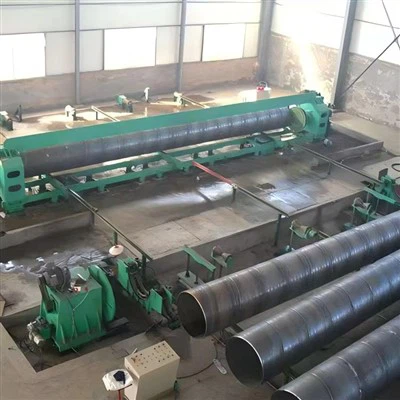
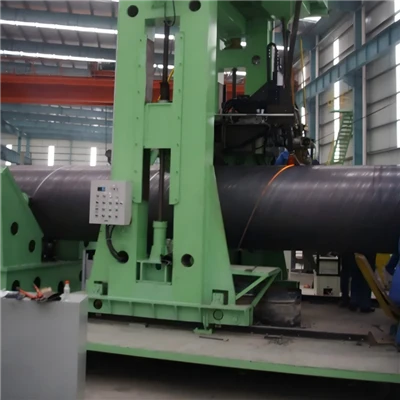
Submerged arc welding has large heat input. It is mainly applied for medium-thick and thick steel plates, generally for plate thickness above 6 mm. It is widely used for carbon steel, low-alloy high-strength steel. It is mainstream process for spiral welded pipe longitudinal & circumferential seam, pressure vessel, boiler cylinder, heavy H-beam, marine steel structure, large storage tank. It is suitable for long straight seams and circular circumferential seams under factory indoor mass production. SAW is not ideal for ultra-thin plate, complex irregular curve seams and outdoor field repair.
Cost and Economic Performance
Manual open-arc welding has low equipment investment. The initial purchase cost of welding machine is cheap. However, manual operation consumes plenty of labor hours. For mass-production long seams, comprehensive labor cost is high.
Submerged arc welding needs higher one-time investment for complete automatic equipment. Besides welding machine, tractor, flux recycling device shall be purchased. But in mass continuous production, high welding speed reduces working hours greatly. Flux can be recycled repeatedly. The unit-meter welding cost will drop obviously for large-volume projects. For small-batch short-seam tasks, SAW will cause waste of flux and equipment capacity, leading to poor economic benefit.

To sum up, submerged arc welding is a special automatic subtype of arc welding. The so-called "arc welding" in daily comparison generally points to open-type manual / semi-automatic arc welding.
Open-arc welding features simple equipment, flexible operation, strong field adaptability, suitable for complex seams, repair work and small-batch production, yet with low efficiency and quality relying heavily on welder skills.
Submerged arc welding adopts flux-slag protection, realizes automatic continuous welding, owns high efficiency, stable weld quality, less spatter and low radiation. It is the preferred process for thick-plate long-seam mass production in steel pipe, pressure vessel and heavy-duty steel-structure industry. Its drawbacks are high equipment investment, limited workpiece-shape adaptability and strict requirements for indoor working environment.
In actual manufacturing projects, factories often combine these two processes together: using submerged arc welding for main long welding seams for mass production, and adopting manual arc welding for partial splicing, repair and complex-position seams, so as to balance production efficiency, welding quality and overall cost.