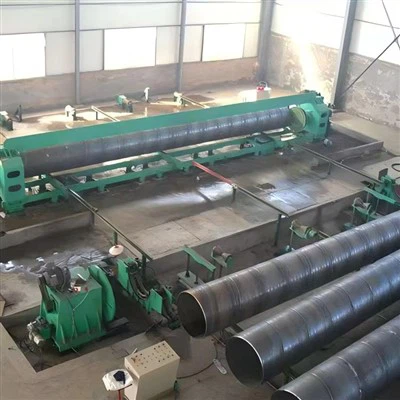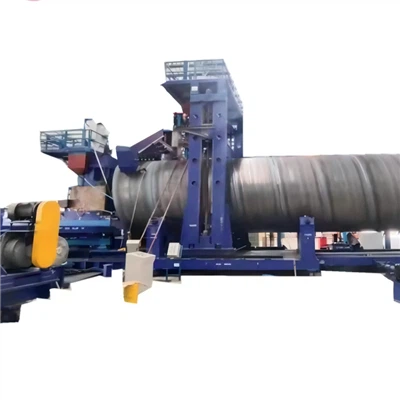
Among the most widely used and efficient automatic welding processes in modern heavy industry and steel pipe manufacturing, one is submerged arc welding (SAW). As a mature technology, SAW features such characteristics as submerged arc, flux protection, deep penetration, stable welding quality, and less spatter. Unlike MIG and TIG (open arc) welding methods, the entire arc and molten pool of submerged arc welding are completely covered and protected by flux, thus isolating the welding area from the air and avoiding oxidation defects. Since industrial production began, submerged arc welding has become the core welding process for spiral welded pipes, thick-walled steel structures, pressure vessels, boiler manufacturing, shipbuilding, and large equipment manufacturing. Due to its suitability for thick plate welding, strong current capacity, and ease of automation, submerged arc welding has occupied an irreplaceable position in heavy industry manufacturing.
Basic Definition and Working Principle
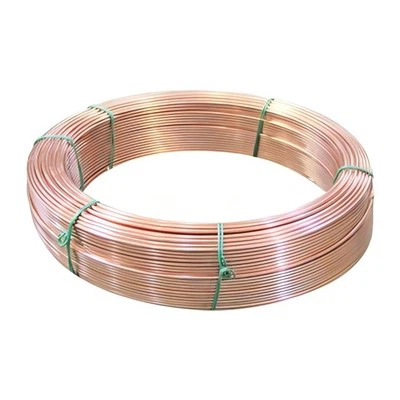
Submerged arc welding is an automatic or semi-automatic arc welding process that uses solid wire as the filler material and flux as the protective medium. The key feature of this process is that during the welding process, the arc is covered by the flux layer, and no open flame can be seen. The entire metallurgical reaction of the welding is completed in a sealed slag protection environment.
Its working principle can be divided into four stages: arc ignition, heat melting, metallurgical reaction, and slag formation protection. When the welding machine starts, the short circuit between the welding wire and the workpiece generates a transient current, thereby igniting the arc. At the same time, the high-temperature arc heat melts the surrounding flux, welding wire, and base material. The melted flux forms a viscous and dense liquid slag layer that can completely cover the high-temperature molten pool. This slag layer can isolate the oxygen, nitrogen, and water vapor in the air, preventing harmful gases from entering the weld seam. At the same time, a series of complex metallurgical reactions occur between the molten slag and the molten steel, such as deoxidation, desulfurization, and dephosphorization, thereby purifying the microstructure of the weld seam and improving the mechanical properties of the welding joint. After cooling, the liquid slag solidifies into a hard shell on the weld surface, which is easy to remove and forms a smooth and uniform weld.
The main equipment and materials of the SAW system
A complete submerged arc welding system consists of professional welding equipment, welding wire and special flux.
1. Welding equipment
The core equipment mainly consists of an automatic welding power supply, wire feeder, welding trolley or mobile gantry system, flux supply and recovery device. The welding power supply provides stable current and voltage to ensure the continuous and stable combustion of the arc. The automatic wire feeder can precisely control the wire feeding speed and match it with the welding movement speed to avoid arc interruption and unstable molten pool. The walking trolley drives the welding gun to move at a uniform speed, ensuring the consistency of weld width and penetration depth. In addition, the automatic flux circulation system can achieve the automatic spreading and recovery of flux, not only ensuring continuous protection during the welding process, but also improving material utilization and thereby reducing production costs.
2. Welding wire and flux
Submerged arc welding relies on the combined effect of the welding wire and the flux to achieve metallurgical optimization. The welding wire provides filler metal and alloy elements, while the flux serves as a protective, deoxidizing, and impurity removal agent. Different types of steel, such as carbon steel, low-alloy high-strength steel, and pipeline steel, require corresponding neutral, acidic, or alkaline fluxes. Among them, alkaline fluxes have a relatively strong impurity removal ability, which can significantly improve the low-temperature toughness and crack resistance of the weld, and are suitable for high-standard pipeline and pressure vessel welding; acidic fluxes have good process performance, stable arc, and beautiful weld formation, and are mainly used for the welding of ordinary structural steel.
Complete Technological Process of Submerged Arc Welding
1. Pre-weld Preparation
Pre-weld treatment is a crucial step in ensuring the quality of the weld. Firstly, the product surface and the weld area must be thoroughly cleaned, removing rust, oxide scales, oil stains, moisture, and other impurities to prevent defects such as pores, slag inclusions, and cracks caused by impurities. Secondly, the flux must be dried at a specific high temperature to remove internal water vapor, thereby reducing the hydrogen content in the weld seam and avoiding hydrogen-induced cold cracking. In addition, the operator needs to adjust the welding assembly gap and weld angle according to the thickness of the sheet and welding standards to ensure uniform penetration layer and good fusion.
2. Parameter Settings and Trial Welding
Before the formal welding process, the staff need to set the core process parameters, including welding current, voltage, arc movement speed, and wire length, etc. The current determines the heat input and penetration depth of the weld; the voltage controls the width of the weld seam and the appearance of the weld bead; the arc movement speed affects the welding efficiency and the quality of fusion. If the parameters are not matched properly, it may result in insufficient penetration depth, burn-through, incomplete fusion, or uneven weld formation. To ensure the stability of the parameters and the qualified weld performance in large-scale production, trial welding must be conducted.
3. Formal welding and flux protection
During the formal welding process, the flux supply device evenly spreads the flux on the weld seam, forming a sufficient thickness of the flux layer. The welding wire is continuously fed in, and the electric arc burns stably beneath the flux layer. The high-temperature electric arc melts the base material and the welding wire, forming a molten pool. At the same time, after the flux melts, a protective slag layer is formed, isolating the air and completing metallurgical purification. The welding cart moves forward at a constant speed to achieve continuous and long-distance welding. For spiral welded pipes and thick-walled steel structures, double-sided submerged arc welding is usually used. The inner weld is done first, followed by the outer weld, to ensure complete penetration and a dense weld structure.
4. Post-welding treatment and inspection
After the welding is completed, wait for natural cooling and remove the surface slag shell. The weld surface is smooth and flat, with good forming quality. For high-quality products such as pipeline steel and pressure vessels, post-weld non-destructive testing such as ultrasonic testing and X-ray flaw detection are required to detect internal cracks, slag inclusions, and incomplete fusion defects. At the same time, mechanical property tests such as tensile tests and impact tests need to be conducted to verify whether the weld strength and toughness meet industrial standards.
Core technological advantages
In the industrial production process, submerged arc welding has irreplaceable technical advantages in thick plate welding and long weld seam welding. Firstly, the flux protection system can completely isolate the air, resulting in very low gas content inside the weld seam and a dense internal structure with excellent mechanical properties. Secondly, submerged arc welding can withstand high currents and achieve large heat input, having good penetration ability, and is particularly suitable for thick plate welding that cannot be completed by ordinary welding processes. Moreover, this automatic welding method has high production efficiency, stable welding process, low defect rate, and very little dependence on human labor. Fourth, the pollution from welding smoke is significantly reduced, improving the on-site working environment and safety. Fifth, the weld seam is smooth and uniform, with almost no spatter, significantly reducing the workload of subsequent grinding and fine processing, and improving production efficiency.

Limitations
Although submerged arc welding has significant advantages, it also has certain technical limitations. Due to the need for flux coverage during the welding process, submerged arc welding is only suitable for flat welding and horizontal welding, and cannot achieve full-position welding such as vertical welding and overhead welding. Therefore, there are positional limitations. In addition, submerged arc welding is not suitable for thin plate welding because the heat input of submerged arc welding is too large, which is prone to causing plate deformation or burn-through. At the same time, due to the large size of the welding equipment, it is not suitable for complex and irregularly shaped small work-pieces as well as mobile construction scenarios. In actual production, strict key process control must be carried out: strictly control the drying temperature of the flux to prevent hydrogen-induced cracks; precisely match the current and voltage to avoid electrode not penetrating or overheating; ensure uniform coverage of the flux to prevent air intrusion; reasonably control the welding speed to stabilize the weld formation.
Main industrial applications
Arc welding is widely used in the heavy industry manufacturing fields where high standards of quality and efficiency are required.
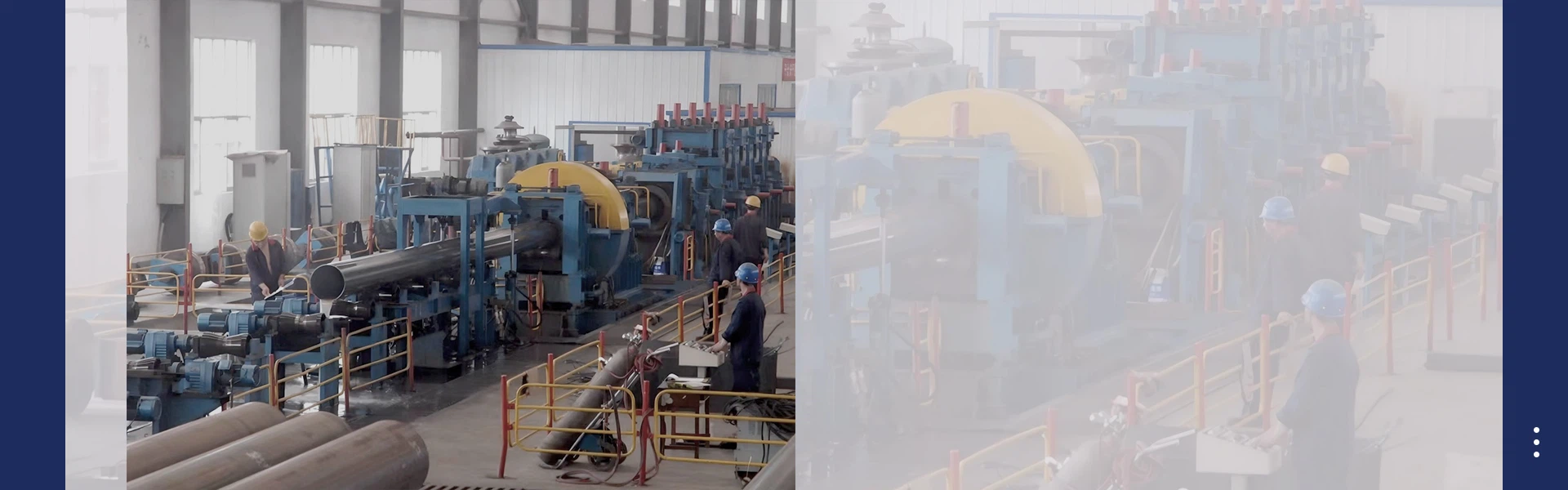
1. In the steel pipe industry, it is a specialized welding process for spiral welded pipes and large-diameter longitudinal seam welded pipes, and is widely used in long-distance oil and gas pipelines, municipal water supply pipelines, and wind power engineering pipelines.
2. In the heavy steel structure industry, submerged arc welding technology is used for bridge steel plates, building load-bearing structures, and port machinery manufacturing.
3. In pressure vessel and boiler manufacturing, this technology is used for thick-walled cylinder welding to ensure high-pressure tolerance and air tightness.
4. In the shipbuilding and marine engineering field, submerged arc welding can ensure the structural stability and corrosion resistance of ship body steel plates and offshore platform components.
With the continuous development of automation and intelligent manufacturing, submerged arc welding technology is gradually evolving towards intelligent parameter adjustment, robot collaborative welding, and efficient welding, further enhancing industrial production efficiency.
Submerged arc welding is an efficient, high-quality and highly automated welding process that achieves welding through the protection of flux and metallurgical purification. Unlike traditional slot arc welding, submerged arc welding uses granular flux for protection, enabling closed welding, effectively eliminating porosity defects and purifying the weld metal, resulting in better mechanical properties. It has significant advantages such as deep penetration, stable process, aesthetic weld appearance, and low defect rate. It is particularly suitable for thick plates, long welds, and large-scale industrial production.
Although it has certain limitations in welding positions and thin plate welding, it still holds a dominant position in heavy industry, pipeline manufacturing, pressure vessel production, and steel structure engineering. In the future, with continuous innovation in welding technology and automatic control systems, submerged arc welding will achieve higher welding efficiency, lower defect rates, and more stable welding performance, continuing to be a core welding process supporting the construction of modern industrial infrastructure.