Introduction
Welded steel pipes occupy a core position in modern energy, water conservancy, municipal administration and structural engineering. Among multiple submerged-arc welded pipe categories, SSAW (Spiral Submerged-Arc Welded steel pipe) and LSAW (Longitudinal Submerged-Arc Welded steel pipe) are two dominant large-diameter pipe solutions widely adopted across global projects.
Both apply submerged-arc welding technology, utilizing granular flux to shield welding arcs and molten metal, obtaining reliable welded joints with high deposition efficiency. Nevertheless, fundamental gaps exist in raw material selection, forming mechanism, weld geometry, residual stress distribution, dimensional tolerance, mechanical performance, inspection requirements, cost structure and applicable engineering scenarios. Misselection between SSAW and LSAW will bring hidden risks of pipeline failure or unnecessary capital waste. This article elaborates their core differences from manufacturing workflow, technical performance, implementation standards, cost-efficiency and practical application, providing reference for pipeline designers, procurement engineers and project contractors.
1. Basic Definition and Manufacturing Process Differences
1.1 SSAW Steel Pipe (Spiral Submerged-Arc Welded Pipe)

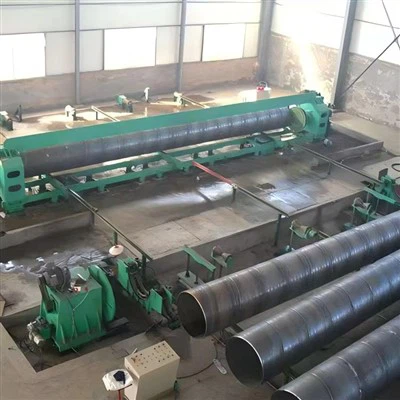
SSAW pipe is also named HSAW (Helical Submerged-Arc Welded pipe). Its raw material is continuous hot-rolled steel coil instead of discrete steel plate. The whole production line runs in continuous feeding mode. Steel coil goes through uncoiling, flattening, edge trimming and milling. Afterwards, strip steel is fed into the forming unit at a preset helix angle relative to pipe centerline. By adjusting this helix angle, steel strips with fixed width can produce steel pipes of varied outer diameters flexibly, which constitutes the most prominent processing advantage of SSAW production.
During continuous spiral forming, internal submerged-arc welding and external submerged-arc welding are completed synchronously. A continuous helical weld seam spirals around the whole pipe body. After welding, pipes are cut to fixed length according to project requirements. Subsequent procedures include hydrostatic testing, visual inspection and non-destructive testing (NDT) for weld seams.
Since SSAW adopts coil-based continuous production, production rhythm is steady. However, the spiral forming procedure will introduce complex residual stress inside pipe walls. Besides, the helical weld seam is far longer than longitudinal weld for pipes with identical dimension. For one-meter pipe body, the actual weld length of SSAW can reach 1.5-3 times of LSAW weld length, theoretically raising the probability of welding defects such as slag inclusion, porosity and incomplete fusion along weld lines.
1.2 LSAW Steel Pipe (Longitudinal Submerged-Arc Welded Pipe)

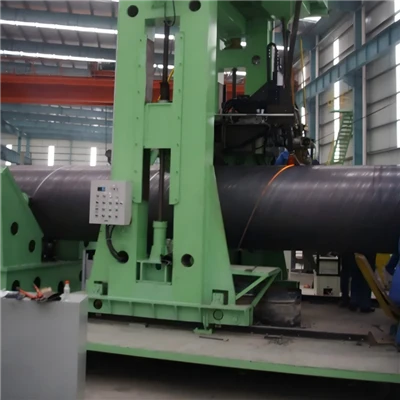
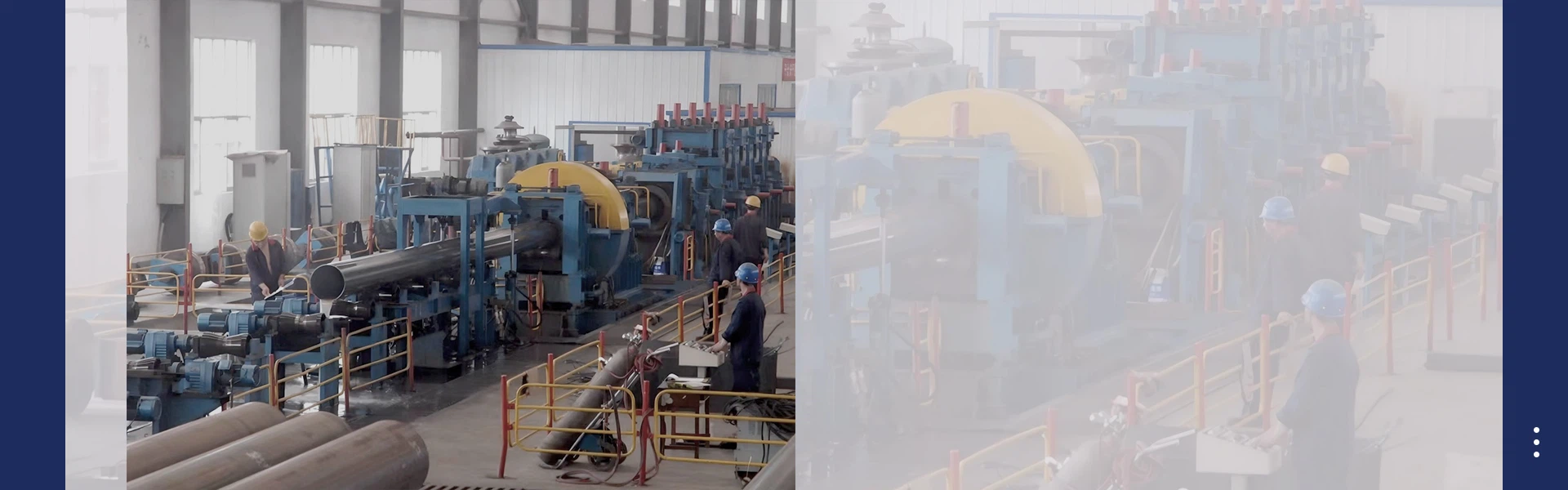
LSAW pipe takes heavy-duty single steel plate as raw material rather than steel coil. Two mainstream forming technologies are UOE and JCOE in global industry. JCOE process is more popular for moderate production volume. Firstly, both edges of steel plate are milled and pre-bent to guarantee good groove geometry. Sequentially, plates go through J-bending, C-bending and O-bending steps, gradually bending flat steel plates into circular pipe shells. After tack welding, internal multi-wire submerged-arc welding and external multi-wire submerged-arc welding are carried out to form one single straight longitudinal weld seam running parallel with pipe axis.
A critical procedure for LSAW production is mechanical cold expansion. The whole pipe is mechanically expanded circumferentially, which calibrates outer diameter, roundness and straightness, and largely releases forming residual stress inside pipe wall. After expansion, hydro-test, ultrasonic inspection, radiographic inspection and other non-destructive examinations are implemented strictly.
Distinct from continuous SSAW production, LSAW belongs to batch-by-batch discrete manufacturing. Each pipe is processed from independent steel plate. The weld seam is one short straight seam. Weld quality monitoring and non-destructive inspection are easier to perform. However, maximum outer diameter of LSAW pipes is restricted by the effective width of purchased steel plates, which becomes one major manufacturing limitation of LSAW products.
2. Raw Material and Specification Range Comparison
2.1 Raw material
SSAW: Input material is hot-rolled steel coil. Coil production restricts maximum achievable wall thickness. Coil supply is cost-competitive for medium-thickness specifications. High-strength heavy-thickness coil resources are limited in global steel market.
LSAW: Input material is cut heavy steel plate. Plate supply supports extremely thick wall and high-strength pipeline steel grades such as X70, X80. Manufacturers can select plate thickness precisely matching project design requirements, without thickness constraints from hot rolling coil mill capacity.
2.2 Outer diameter range
SSAW: Typical OD range 219 mm-3000 mm (8-120 inches). It can realize extra-large diameter production economically, which is the outstanding strength of SSAW. One fixed-width steel coil can produce multiple pipe diameters by adjusting helix angle, bringing high production flexibility for large-diameter projects.
LSAW: Typical OD range 406 mm-1626 mm (16-64 inches). Max diameter is limited by steel plate width. To obtain larger-diameter LSAW pipes, extra-wide steel plates must be ordered, which sharply lifts material cost and lead-time pressure.
2.3 Wall thickness capacity
SSAW: Usual wall thickness ≤20-25 mm. When wall thickness exceeds this threshold, hot-rolled coil resources become scarce, production difficulty rises remarkably, and comprehensive cost advantage fades away.
LSAW: Wall thickness can reach 50 mm or even higher. LSAW is the preferred welded pipe solution for thick-wall, high-pressure working scenarios. Thick-wall heavy-duty steel plates are readily available from major steel mills worldwide.
2.4 Single pipe length
SSAW: Continuous production supports long single pipe length up to 30 meters. Fewer field circumferential weld joints will be generated during pipeline construction.
LSAW: Limited by steel plate length, common single pipe length is 12-18 meters. More field welding joints are needed for long-distance laying projects.
3. Mechanical Performance, Residual Stress and Dimensional Accuracy
3.1 Residual stress
Residual stress significantly affects pipeline service life, anti-stress-corrosion-cracking performance and fatigue resistance.
SSAW: Complex tensile residual stress remains after spiral forming. Even after hydrostatic test, partial forming stress cannot be fully eliminated. Residual tensile stress raises risks of stress corrosion cracking when pipes are buried in corrosive soil environment with underground water.
LSAW: Mechanical cold-expansion process effectively releases forming residual stress. Residual stress level stays low and evenly distributed across pipe body, greatly improving safety performance for long-term underground service.
3.2 Dimensional precision
Roundness, straightness and wall-thickness uniformity directly influence field fit-up quality and welding quality during pipeline installation.
SSAW: Ovals and straightness deviation are relatively obvious. Typical ovality tolerance can reach up to 1.0 % of nominal outer diameter, affected by spiral spring-back effect after forming.
LSAW: Mechanical expansion delivers superior dimensional performance. Ovality can be controlled within 0.5 % of nominal OD. Wall thickness and circumference dimension maintain high consistency, simplifying field butt-welding construction and lowering re-work rate on-site.
3.3 Weld seam feature and defect risk
SSAW features long spiral weld. Total weld length is large. Though modern automatic NDT equipment is applied, spiral curved track brings higher inspection complexity. Potential welding defects distribute along long helical path. When internal pressure loads apply, spiral weld decomposes hoop stress at helix angle. Under qualified manufacturing, SSAW meets medium-pressure design criteria, but is not the optimal choice for ultra-high-pressure critical trunk lines.
LSAW owns one short straight weld seam parallel with pipe axis. Hoop stress from internal pressure acts perpendicularly to weld seam. Weld inspection is straightforward. Defect-controlling difficulty is much lower. LSAW demonstrates excellent low-temperature toughness and cyclic fatigue performance, suitable for harsh working environments including cold regions, seismic zones and offshore projects.
4. Relevant Industry Standards
Both SSAW and LSAW can comply with API 5L (Petroleum and natural gas industries-Steel pipe for pipeline transportation systems), which is the most-recognized global pipeline standard. However, design codes impose differentiated restrictions for risk-classified zones.
For LSAW pipes: Widely accepted by API 5L, DNV-OS-F101 for offshore pipelines, CSA Z245, EN 10217 and other rigorous specifications. Design codes normally specify LSAW for Class 1 and Class 2 high-risk areas: densely-populated zones, alpine cold regions, offshore sub-sea pipelines, high-pressure main trunk lines for oil-gas transmission.
For SSAW pipes: Applied under API 5L, ASTM A252 (piling pipe), EN 10219 structural standard, GB/T 5037 for low-pressure fluid transportation. SSAW is mainly permitted for Class 3 and Class 4 low-risk zones: sparsely-populated districts, water conveyance, sewerage, piling and structural applications. Many engineering specifications prohibit SSAW from being adopted for high-pressure trunk lines passing through dense residential regions.
5. Cost-efficiency Analysis
Under same nominal outer-diameter specification: SSAW shows prominent cost advantage for large-diameter and medium-wall-thickness scenarios. Continuous coil-feeding production improves material utilization rate, lowers unit manufacturing expense. For projects demanding large-diameter pipes without ultra-high-pressure requirement, SSAW can cut total procurement investment substantially.
LSAW cost is generally 30-50 % higher than equivalent-diameter SSAW pipe. Higher cost originates from expensive heavy steel plates, discrete JCOE/UOE forming equipment investment, cold-expansion process and stricter full-range inspection procedures. Nevertheless, in critical energy infrastructure projects, reduced failure risk and extended service cycle offset the premium purchase price, bringing better whole-life-cycle economic returns for high-risk pipeline systems.
When wall-thickness goes up to heavy-wall range, SSAW's cost advantage disappears, and LSAW becomes more competitive.
6. Typical Application Scenarios
6.1 Typical applications for SSAW steel pipe
Municipal large-diameter water supply, raw-water diversion, wastewater discharge and irrigation pipelines with medium-low working pressure.
Steel pipe piles for wharves, bridges, foundation engineering, underground casing pipes.
Structural columns for large-scale steel-structure buildings.
Medium-low-pressure oil-gas gathering pipelines in remote, sparsely-populated non-critical zones.
Circulating water piping for power plants, mine ventilation and tailing-slurry transportation pipes with anti-corrosion treatment.
6.2 Typical applications for LSAW steel pipe
Long-distance high-pressure oil and gas main trunk pipelines, especially sections crossing densely-populated urban areas, seismic belts and frigid zones.
Off-shore platform piping, sub-sea pipeline segments, riser auxiliary structures under DNV specification.
High-pressure city gas transmission network and petrochemical process piping.
Critical structural components bearing heavy cyclic loads, requiring outstanding low-temperature impact toughness.
Projects with strict requirements for dimensional accuracy and field butt-welding performance.
7. Guidance for Engineering Selection
Project engineers shall balance working pressure, risk classification of route zone, operating temperature, medium corrosivity, outer-diameter & wall-thickness parameters, construction conditions and total-budget constraints to select pipe type reasonably.
Choose SSAW when: Project requires extra-large-diameter pipe, working pressure belongs to medium-low grade, route locates at low-risk area, and cost-control is a major priority. Meanwhile, complete hydrostatic testing and full-range NDT shall be implemented, anti-corrosion and cathodic-protection systems should be well-designed to mitigate residual-stress-related corrosion risk.
Choose LSAW when: Pipeline undertakes high-pressure fluid transportation, route passes high-risk population-concentrated zones, service environment features low temperature, cyclic load or corrosive medium, wall-thickness is thick, and high-safety redundancy is required. Even though initial procurement cost increases, LSAW reduces long-term operational risk and potential accident losses.
It is incorrect to simply judge one pipe type as absolutely superior to another. Both SSAW and LSAW are mature submerged-arc-welded pipe products. Quality depends not merely on forming technology, but also raw-material quality, manufacturing management level, welding procedure qualification and strict non-destructive inspection execution. Unqualified production will generate hidden hazards regardless of SSAW or LSAW type.
SSAW and LSAW are two important large-diameter submerged-arc welded pipe solutions. Their core differences root in raw-material selection and forming-welding mechanism, further reflected in residual-stress distribution, dimensional tolerance, weld-seam characteristics, wall-thickness capacity, cost structure and applicable engineering boundaries.
SSAW shines in economical extra-large-diameter medium-pressure projects.
LSAW provides higher safety margin for high-pressure, high-risk critical infrastructure.
Fully understanding these distinctions helps technical personnel make rational pipe-specification decisions, ensuring pipeline safety and reasonable project-cost control.